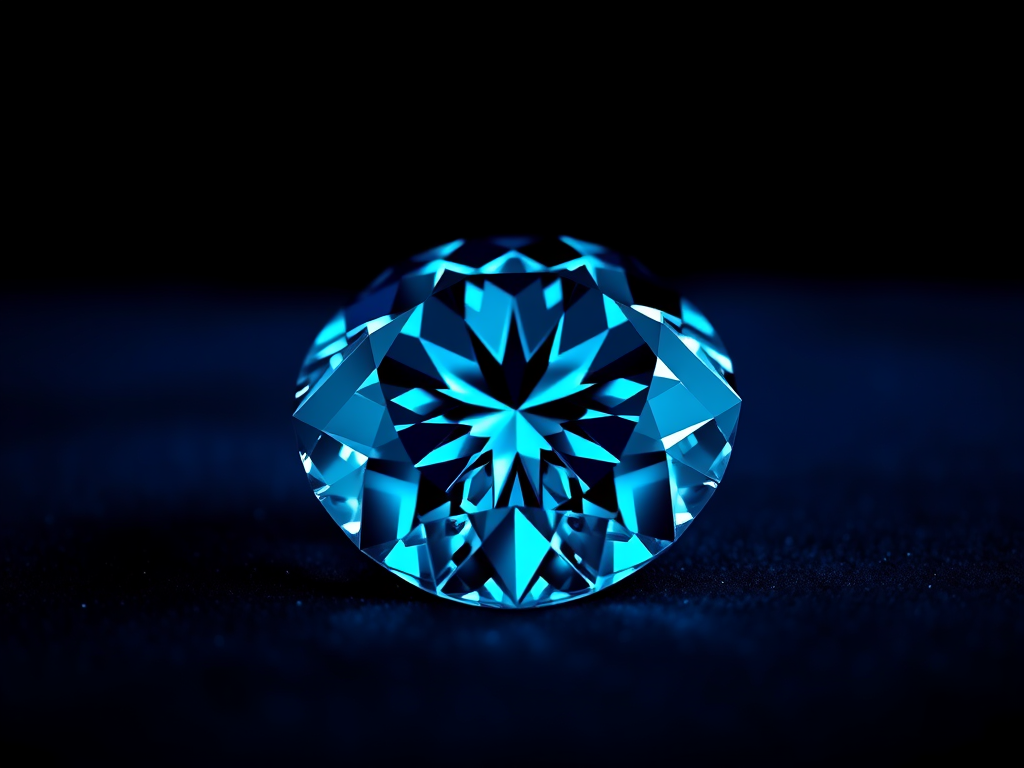
# **Blue Diamonds: Rare Treasures and a Long-term Investment Choice**
Blue diamonds are the focus of attention in the jewelry market and among high-net-worth investors due to their rare natural color, high value, and unique historical background. These rare gemstones not only display unparalleled beauty but also demonstrate exceptional return potential in the investment market. The value of high-quality blue diamonds has steadily increased over the past decade, symbolizing a legacy asset and wealth preservation.
This article will explore the investment value of blue diamonds from multiple perspectives, including market performance over the past decade, investment costs and risks, investment channels, preservation methods, value assessment, authentication methods, investment steps, related expenses, and regulations, providing comprehensive guidance for readers looking to venture into blue diamond investments.
—
## **1. Investment Value of Blue Diamonds**
### **1. Rarity and Uniqueness** Blue diamonds are among the rarest and most sought-after types of colored diamonds, accounting for only **0.02%** of the world’s diamond production. Their unique blue color comes from the presence of trace boron during the natural crystallization process, which is extremely rare, leading to a very limited supply of blue diamonds.
– **Famous Blue Diamonds**: – **Hope Diamond**: One of the most famous blue diamonds in the world, weighing 45.52 carats, currently housed in the Smithsonian National Museum of Natural History in the United States. – **Oppenheimer Blue**: Sold for **$57.5 million** in 2016, setting a record for blue diamonds at auction.
### **2. Investment Return Potential** – **Stable Price Growth**: According to data from the Fancy Color Research Foundation (FCRF), the price of blue diamonds has averaged an annual increase of **8%-12%** over the past 10 years, outperforming most other gemstones and traditional safe-haven assets like gold. – **High Demand in the Auction Market**: High-quality blue diamonds frequently achieve high prices at renowned auction houses such as Christie’s and Sotheby’s, reflecting their popularity among the wealthy elite globally.
—
## **2. Market Performance of Blue Diamonds: The Past Decade**
### **1. Price Growth Data** – **2010-2020 Market Data**: – Fancy Deep Blue and Fancy Vivid Blue diamonds saw annual price growth of approximately **10%-15%**. – Prices for smaller blue diamonds (1-3 carats) increased by around **6%-8%**, while larger blue diamonds (3 carats and above) surged at rates of **15%-20%**.
### **2. Auction Records** – **2022**: “The De Beers Cullinan Blue” sold for **$57.4 million**, becoming the second-highest priced blue diamond in auction history. – **2015**: “Blue Moon of Josephine” sold for **$48.3 million**, achieving a world record price per carat at the time (approximately **$4.03 million/carat**).
These data demonstrate that the market demand for blue diamonds remains robust, with stable price growth, particularly during periods of high economic uncertainty, making blue diamonds a preferred safe-haven asset.
—
## **3. Investment Costs of Blue Diamonds**
### **1. Purchase Price Range** – **Fancy Light Blue**: Approximately **$50,000-$150,000** per carat. – **Fancy Vivid Blue**: Approximately **$500,000-$1,500,000** per carat. – **Top-tier Blue Diamonds** (e.g., Fancy Deep Blue over 3 carats): Prices can exceed **$2,000,000** per carat.
### **2. Other Related Costs** – **Certification Fees**: Ensure blue diamonds come with GIA certification, with fees ranging from **$100-$1,000**, depending on the gemstone’s value. – **Insurance Costs**: Annual insurance costs are typically **0.5%-1%** of the diamond’s value. – **Storage Costs**: Professional safe deposit or bank storage fees are approximately **$300-$1,000** per year.
—
## **4. Investment Risks of Blue Diamonds**
### **1. Market Liquidity Risk** Due to the high price and rarity of blue diamonds, finding suitable buyers may take time, especially during economic downturns.
### **2. Risk of Fakes and Treatments** There are blue diamonds on the market that have undergone artificial treatments (such as radiation treatment or coating), which significantly decreases their value compared to natural blue diamonds.
### **3. Short-term Volatility Risk** Although blue diamonds have stable long-term price trends, short-term fluctuations may occur due to economic factors or changes in market demand.
—
## **5. Investment Channels**
### **1. Auction Houses** – **Christie’s** and **Sotheby’s** are primary channels for purchasing high-end blue diamonds, offering rare auction-grade blue diamonds with complete certification reports. – **Fees**: Approximately **10%-25%** buyer’s premium.
### **2. Premium Jewelry Brands** – Brands like **Graff**, **Harry Winston**, and **Tiffany & Co.** frequently offer high-quality blue diamonds suitable for long-term investment and collection. – **Advantages**: High brand value and secure transactions.
### **3. Diamond Exchanges** – The **Antwerp World Diamond Centre (AWDC)** and the **Israel Diamond Exchange (IDE)** are primary trading platforms for professional investors, providing transparent pricing and a wide selection.
—
## **6. Preservation and Security Methods**
### **1. Professional Storage and Insurance** – **Storage**: Use bank safety deposit boxes or professional jewelry storage facilities to avoid damage or loss. – **Insurance**: Purchase specialized jewelry insurance covering damage, theft, and natural disasters.
### **2. Regular Inspection and Maintenance** – Regularly check the condition of blue diamonds to ensure they maintain their brilliance.
—
## **7. Value Assessment Factors**
### **1. Color** – Higher saturation colors like Fancy Vivid Blue and Fancy Deep Blue hold the highest value; the more vivid the color, the rarer it is.
### **2. Carat Weight** – The value of blue diamonds increases exponentially with carat weight, especially for those over 3 carats, which are particularly rare.
### **3. Clarity** – High clarity (such as IF and VVS) blue diamonds are favored in the market, but in colored diamonds, color is more important than clarity.
### **4. Cut** – The quality of the cut directly affects the diamond’s brilliance and color display, making it a crucial factor in value assessment.
### **5. Provenance and Certification** – Blue diamonds should come with GIA (Gemological Institute of America) or other authoritative certification to confirm their color and natural origin.
—
## **8. Authentication Methods**
1. **GIA or IGI Certification** – Ensure blue diamonds come with certification from GIA or IGI, confirming they are natural and untreated blue diamonds.
2. **Professional Instrument Testing** – Use spectrometers to test the gem’s optical properties to distinguish natural blue diamonds from treated ones.
3. **Magnification Inspection** – Use a 10x magnifying glass to check for inclusions and color distribution; treated blue diamonds may show unnatural color zoning.
—
## **9. Investment Steps**
1. **Research the Market and Targets** – Understand the value assessment criteria and market trends for blue diamonds.
2. **Choose Reputable Channels** – Purchase through auction houses, brand jewelers, or exchanges.
3. **Verify Provenance and Certification** – Ensure blue diamonds come with authoritative certification.
4. **Purchase Insurance and Storage** – Insure the diamond and store it in secure facilities.
5. **Regularly Assess and Manage** – Regularly assess the market value of blue diamonds and adjust investment strategies according to market dynamics.
—
## **10. Related Costs**
1. **Auction Premium**: Approximately **10%-25%**. 2. **Certification and Report Fees**: Approximately **$100-$1,000**. 3. **Insurance and Storage Costs**: Approximately **$300-$1,000** per year.
—
## **11. Regulatory and Tax Considerations**
1. **Import and Export Regulations** – Some countries have specific regulations regarding the import and export of diamonds, requiring proof of provenance.
2. **Tax Considerations** – Selling blue diamonds may incur capital gains tax, with specific rates depending on the country.
3. **Estate and Gift Taxes** – As legacy assets, blue diamonds may be subject to related estate or gift taxes.
—
## **12. Conclusion**
Blue diamonds, with their rarity, exceptional appreciation potential, and cultural value, have become a star category in the high-end jewelry investment market. Whether as a wealth preservation tool or a long-term investment, blue diamonds display unparalleled allure. For prospective investors, choosing high-quality blue diamonds, trading through reliable channels, and ensuring proper storage will add a timeless brilliance to your investment portfolio.
## **Market Cycle Analysis of Blue Diamonds**
As one of the rarest colored diamonds, the market for blue diamonds is influenced by various factors, including supply scarcity, demand from high-end consumers, global economic fluctuations, and investor psychology. Although the price of blue diamonds has shown a long-term upward trend, the market performance still exhibits certain cyclical and volatile characteristics in the short term. Below is a detailed analysis of the cyclicality of the blue diamond market.
—
### **1. Supply-side Influences**
The supply cycle of blue diamonds is primarily affected by mining operations and global production levels.
#### **1. Mining Supply Constraints** – Blue diamonds mainly come from a few select mines, the most famous being South Africa’s **Cullinan Mine**, which has produced many notable blue diamonds, such as **The Blue Moon Diamond**. – The global production of blue diamonds is extremely low, accounting for only **0.02%** of all diamond production each year, with most being small carat or light-colored diamonds. – Due to limited resources in these mines, the supply of blue diamonds is non-renewable. Once primary mine resources are exhausted, the supply will further decrease, affecting the long-term supply-demand balance in the market.
#### **2. Impact of Mine Closures** – The closure of mines directly exacerbates supply shortages in the market. For example, after the closure of Australia’s **Argyle Mine** in 2020, the price of pink diamonds rose sharply; a similar situation could occur in the blue diamond market.
#### **3. Seasonal Mining Operations** – The operational cycles and production levels of diamond mines may be affected by seasonal factors (such as weather conditions), but the impact on blue diamonds is minimal due to their extreme rarity.
—
### **2. Demand-side Cyclical Changes**
The demand cycle for blue diamonds is closely related to macroeconomic conditions, the purchasing power of the wealthy, and investor behavior.
#### **1. Global Economic Fluctuations** – **Economic Boom**: During periods of global economic stability or prosperity, demand for blue diamonds increases among high-net-worth individuals and luxury consumers, leading to price rises. At this time, blue diamonds are often viewed as luxury items and status symbols. – **Economic Uncertainty**: When the global economy faces uncertainties (such as financial crises or geopolitical tensions), blue diamonds, as rare physical assets, become part of hedge investments, possibly leading to surges in demand. For instance, after the 2008 financial crisis, the appreciation potential of colored diamonds attracted more investors.
#### **2. Consumer Behavior Cycles** – **Wedding and Holiday Demand**: Blue diamonds may experience short-term demand spikes during wedding seasons (such as spring and fall) and major holidays (like Christmas and Chinese New Year). This demand primarily comes from high-end jewelry consumers rather than pure investors. – **Cultural and Market Trends**: The market demand for blue diamonds may experience short-term fluctuations due to the influence of celebrity jewelry or significant auction events. For example, after the record-breaking auction of the Oppenheimer Blue in 2016, global attention toward high-end blue diamonds significantly increased.
#### **3. Regional Demand** – **Asian Market**: The wealthy classes in China and India have shown significant growth in demand for colored diamonds over the past decade, particularly blue diamonds, as they symbolize wealth and prestige. – **Western Market**: In Europe and North America, demand for blue diamonds is more concentrated in auction houses and high-end jewelry brands, primarily for collection and investment purposes.
—
### **3. Cyclicality of the Auction Market**
#### **1. Price Fluctuations Around Auction Events** – The price of blue diamonds may exhibit short-term fluctuations before and after significant auction events. For instance, top blue diamonds often fetch record prices at Christie’s or Sotheby’s auctions, driving attention and demand in the market. – Some investors may choose to sell mid-sized blue diamonds after major auctions to achieve higher market premiums.
#### **2. Auction Seasons** – Auction houses typically hold major jewelry auctions in spring (March to June) and fall (September to December), during which the trading volume and demand for blue diamonds may increase significantly.
—
### **4. Investor Psychology and Market Cycles**
#### **1. Long-term Investment Mindset** – Most blue diamond investors view them as long-term appreciating assets, leading to a slower circulation of supply in the market, which helps stabilize prices over time.
#### **2. Short-term Arbitrage Behavior** – Some investors may take advantage of market hotspots (such as auction record prices or media coverage) for short-term arbitrage, which may lead to temporary price fluctuations but has limited impact on long-term price trends.
### **5. Anti-Cyclical Nature of the Blue Diamond Market**
Despite the cyclical fluctuations in the blue diamond market, its long-term price trend exhibits significant anti-cyclical characteristics:
1. **Inflation and Currency Depreciation Hedge** – As a physical asset, blue diamonds have a strong ability to combat inflation and currency depreciation, especially during periods of global economic instability, making them a safe haven for investors.
2. **Low Correlation with Stock Market Fluctuations** – Unlike financial assets such as stocks and bonds, the price movements of blue diamonds are minimally correlated with global stock market fluctuations, providing diversification and stability to investment portfolios.
3. **Supply Scarcity Secures Price Stability** – The scarcity of natural blue diamonds ensures that their prices will not be adversely affected by market oversupply in the long term. As mine resources deplete, their anti-cyclical value becomes even more pronounced.
—
### **6. Conclusion**
The cyclicality of the blue diamond market is influenced by multiple factors, but its long-term scarcity and investment value make it an anti-cyclical asset. Investors should carefully consider the impact of short-term market fluctuations when investing in blue diamonds and aim for long-term appreciation. By understanding factors such as mining supply, economic fluctuations, auction markets, and investor psychology, you can better grasp the cyclical characteristics of the blue diamond market and develop suitable investment strategies for stable asset appreciation.