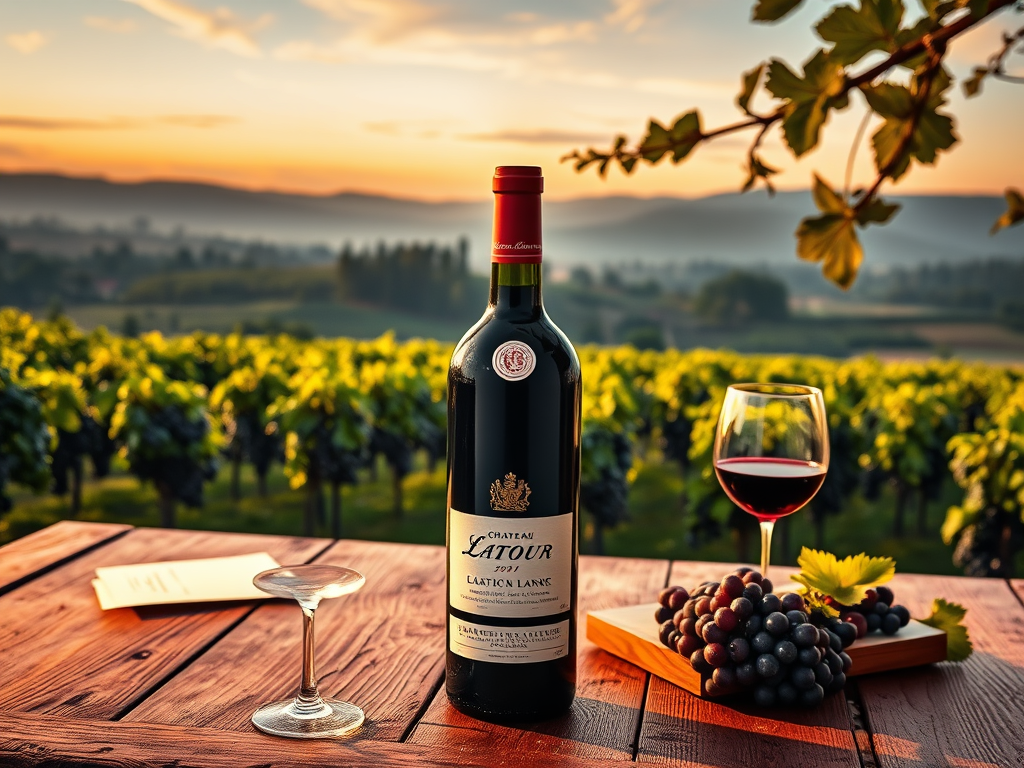
# Investing in Château Latour: Steady Returns and Long-Term Value of Top-Quality Wine
**Château Latour**, one of the five First Growths of Bordeaux, is among the most renowned investment-grade wines globally. Its exceptional quality, rich history, and stable market performance make it a top choice for wine investors. Latour’s strong aging potential and rarity provide significant investment appeal in the wine market. This article will comprehensively analyze the value and steps for investing in Château Latour, helping you seize this “liquid gold” investment opportunity.
—
## 1. Investment Value
1. **Brand Position and Historical Background** Château Latour is located in the Pauillac region of Bordeaux and has been a leader in the wine industry since the 14th century. Rated as a “First Growth” in the 1855 Bordeaux classification, its outstanding quality and stable market value have made it a symbol of luxury wine.
2. **Exceptional Quality and Aging Potential** Château Latour is known for its rich structure, deep flavors, and extremely long aging potential, with many vintages maintaining peak condition decades after bottling. This high demand enhances its value in the collecting and investment market.
3. **Scarcity Driving Value** With an annual production of only about 18,000 cases, Château Latour is extremely scarce compared to global demand. Additionally, in 2012, Latour announced its withdrawal from the En Primeur sales system, choosing to release wines only in favorable vintages, further increasing market value.
4. **Strong Market Demand** Latour has shown stable performance in European and American markets, while demand in Asian markets (especially China) has significantly increased over the past decade, driving up prices.
—
## 2. Investment Returns: Market Performance Over the Past Decade
Château Latour has demonstrated stable market performance over the past ten years, particularly in high-quality vintages, with remarkable price increases. Here are the market performances of several representative vintages:
1. **Latour 2000 Vintage** – **2013**: Market price per bottle approximately £1,200 (about $1,560). – **2023**: Market price per bottle has reached £3,800 (about $4,940), an increase of over 200% in ten years.
2. **Latour 1982 Vintage** – **2013**: Market price per bottle approximately £5,000 (about $6,500). – **2023**: Market price per bottle has soared to £16,000 (about $20,800), an increase of over 220%.
3. **Latour 2010 Vintage** – **2013**: Market price per bottle approximately £1,000 (about $1,300). – **2023**: Market price per bottle has risen to £3,000 (about $3,900), an increase of 200%.
4. **Average Returns of Latour** According to the **Liv-ex Fine Wine 100 index**, Château Latour’s annualized return rate is consistently between 8% and 12%, outperforming most financial assets.
—
## 3. Investment Costs
1. **Entry-Level Vintages** – **Price Range**: £500-£1,000 (about $650-$1,300) per bottle. – **Representative Vintages**: 2014, 2017, and other average years.
2. **Mid to High-End Vintages** – **Price Range**: £1,500-£5,000 (about $2,000-$6,500) per bottle. – **Representative Vintages**: 2000, 2005, 2010, and other high-quality, in-demand years.
3. **Top Vintages** – **Price Range**: £10,000-£50,000 (about $13,000-$65,000) per bottle. – **Representative Vintages**: 1982, 1945, 1961, and other rare years.
4. **Other Costs** – **Storage Fees**: Approximately £10-£30 (about $13-$40) per bottle per year for professional wine cellars. – **Insurance Fees**: Approximately 1% of the wine’s value per year. – **Transaction Fees**: Auction platform or trading platform fees are around 10%-20%.
—
## 4. Investment Risks
1. **Market Volatility** While Château Latour has shown long-term stability, prices may fluctuate in the short term due to economic cycles, currency fluctuations, or market demand.
2. **Vintage Risk** Performance can vary significantly between vintages, with ordinary years often having less appreciation potential than top vintages.
3. **Counterfeit Risk** As a high-priced top wine, Latour is a target for counterfeiters, making authenticity verification crucial.
4. **Storage Risk** Improper storage can lead to deterioration of wine quality or damage to packaging, directly affecting investment value.
4. **Private Collection Transactions** – Purchase through wine collector communities or wine clubs, but be cautious about authenticity verification.
—
## 6. Collection and Preservation Methods
1. **Professional Storage Conditions** – **Temperature**: Maintain a constant temperature of 12℃-15℃. – **Humidity**: Approximately 70%, to prevent cork drying or label damage. – **Environment**: Avoid light, vibration, and odors.
2. **Professional Wine Cellar Storage** – Use professional wine cellar services (such as **Octavian Vaults**) to ensure safe storage.
3. **Insurance and Record Keeping** – Insure high-value wines, and keep purchase receipts, storage records, and transaction documents.
—
## 7. Value Assessment Factors
1. **Vintage** – Quality vintages (such as 1982, 2000, 2010) have greater appreciation potential.
2. **Bottle Size** – Larger formats (such as Magnum, Jeroboam) typically hold more value due to rarity and greater aging potential.
3. **Condition and Storage Conditions** – Bottles in pristine condition with undamaged liquid are more valuable investments.
4. **Market Demand** – The demand for Latour in the Asian market (especially China) significantly impacts its price.
—
## 8. Authenticity Verification Methods
1. **Check the Label** – Château Latour labels feature a distinctive tower logo, with clear details and security measures.
2. **Bottle and Seal Inspection** – Verify the integrity of the cork and seal, and check for laser numbering on the bottle (for certain vintages).
3. **Original Wooden Box and Certificate** – The original wooden box and official certificate enhance the credibility of authenticity verification.
4. **Professional Appraisal** – Hire professional appraisal services or verify authenticity through official channels of the winery.
—
## 9. Investment Steps
1. **Market Research** – Collect historical price trends, popular vintages, and market demand data for Latour.
2. **Select Investment Vintages** – Choose vintages and bottles with appreciation potential according to your budget.
3. **Choose Purchase Channels** – Prioritize auction houses or professional trading platforms to ensure transaction security and transparency.
4. **Proper Storage** – Ensure wines are stored in a professional environment and conduct regular checks.
5. **Regular Evaluation and Sale** – Based on market changes, select appropriate times to sell for returns.
—
## 10. Related Costs
1. **Purchase Costs** – Ordinary vintages start at £500, while top vintages can exceed £10,000.
2. **Storage Costs** – Professional storage costs approximately £10-£30 per bottle per year.
3. **Insurance Costs** – Approximately 1% of the wine’s value per year.
4. **Transaction Costs** – Auction house or trading platform fees are approximately 10%-20%.
5. **Appraisal Costs** – Each appraisal costs around £100-£300.
—
## 11. Conclusion
Château Latour, with its outstanding quality, rarity, and long-term stable market performance, is an ideal choice for wine investors. Whether as a collectible or an investment asset, Latour demonstrates strong appreciation potential and cultural value. By selecting the right vintages, storing properly, and trading carefully, you can achieve substantial returns in this top-quality wine market.
To protect your valuable wine collection and investment, purchasing professional wine insurance is essential. Wine insurance can cover various risks, including storage, transportation, and natural disasters, ensuring your wine investments are adequately protected in case of unforeseen events. Below are some recommended insurance companies and their plans, along with factors to consider when choosing wine insurance.
—
## 1. Recommended Wine Insurance Companies and Plans
### **1. Axa XL Art & Lifestyle** – **Overview**: Axa XL is a well-known global insurer specializing in high-value assets, and its “Fine Wine Insurance” is designed specifically for valuable wine collections. – **Coverage**: – Damage, theft, and fire when wine is stored in cellars or professional warehouses. – Accidental damage or loss during transportation. – Losses due to natural disasters (e.g., earthquakes, floods, storms). – **Suitable For**: Individual collectors, merchants, auction houses, and investors. – **Features**: – Insurance available for cellars worldwide. – Flexible coverage options available per bottle, per case, or overall value.
—
### **2. Chubb Insurance** – **Overview**: Chubb is one of the largest high-end private insurers globally, focusing on insuring high-value assets such as art, antiques, and wine. – **Coverage**: – Losses due to fire, theft, damage, and natural disasters. – Damage or loss during transportation or movement. – **Suitable For**: Individual collectors and wine investors. – **Features**: – Offers “full value coverage,” ensuring maximum compensation even if the wine’s market value increases. – Annual assessment and adjustment based on the market value of collectibles.
—
### **3. Hiscox** – **Overview**: Hiscox specializes in insuring high-value personal collections, including wine, art, and jewelry. – **Coverage**: – Losses from fire, theft, or accidental damage to wine stored in cellars. – Damage to wine due to natural disasters (e.g., floods or earthquakes). – Damage during transportation, exhibition, or trading. – **Suitable For**: Private collectors and high-end wine investors. – **Features**: – Offers professional valuation services for collectibles. – Coverage includes global transportation.
—
### **4. Willis Towers Watson** – **Overview**: Willis Towers Watson is a leading global insurance brokerage that provides professional insurance solutions for high-end collectibles, including wine. – **Coverage**: – Accidental loss of wine during storage (in cellars, professional warehouses) or transportation. – Damage to bottles or external packaging. – **Suitable For**: Professional merchants, private collectors, and investors. – **Features**: – Flexible insurance plans tailored to the value of the collection. – Comprehensive risk management advice.
—
### **5. Lloyd’s of London** – **Overview**: Lloyd’s is the world’s oldest professional insurance market, offering comprehensive coverage for rare wine collections. – **Coverage**: – Losses of wine stored in cellars due to fire, flood, theft, etc. – Damage or loss during transportation. – Effects of natural disasters (e.g., earthquakes, storms) on stored wine. – **Suitable For**: Private collectors, large investors, and wineries. – **Features**: – Broad coverage suitable for global wine collections. – Professional risk assessment and global transportation coverage.
—
## 2. Coverage of Wine Insurance
When purchasing wine insurance, it’s essential to understand the typical coverage areas:
1. **Damage Coverage** – Includes breakage of bottles, leakage of wine, and damage to labels. – Loss of wine due to accidental incidents (e.g., fire, flood, earthquake).
2. **Theft Coverage** – Value loss after the theft of the collected wine.
3. **Transportation Coverage** – Accidental damage or loss during transportation, especially in international shipping.
4. **Market Value Fluctuation** – Some high-end insurance plans cover compensation for market value increases.
5. **Natural Disasters** – Damage caused by natural disasters like earthquakes, floods, and storms to cellars or storage facilities.
—
## 3. Factors to Consider When Choosing Wine Insurance
1. **Insurance Amount** – The insurance amount should match the market value of your wine collection and be regularly assessed and adjusted.
2. **Coverage Scope** – Ensure the insurance covers all potential risks, including storage, transportation, and natural disasters.
3. **Global Applicability** – If your wine collection requires international transportation or storage, the insurance should have global applicability.
4. **Market Value Compensation** – Choose a policy that compensates according to the current market value of the wine to accommodate market price fluctuations.
5. **Premium Cost** – Premiums typically range from 0.5% to 1% of the wine’s value annually, assessed based on the collection size and coverage scope.
6. **Professional Valuation Services** – Quality insurance companies usually provide professional wine valuation services to help determine the insurance amount.
—
## 4. How to Purchase Wine Insurance
1. **Assess Collection Value** – Conduct a comprehensive assessment of your wine collection’s value (vintage, quantity, rarity) to determine insurance needs.
2. **Choose an Appropriate Insurance Company** – Select an insurance company that offers professional services based on the size and needs of your collection.
3. **Confirm Coverage Scope** – Carefully read the policy terms to ensure all potential risks are covered.
4. **Regularly Update the Policy** – As the market value of wine changes, regularly update the insurance amount and coverage scope.
—
## 5. Advantages of Wine Insurance
1. **Protect Investment** – Wine, as a high-value asset, can effectively prevent economic losses due to accidents.
2. **Reduce Risk** – Insurance provides comprehensive protection against risks in both storage and transportation.
3. **Enhance Collection Value** – Insured wine collections are more attractive to buyers, increasing market liquidity.
—
## 6. Conclusion
Wine insurance is an essential tool for protecting your investment, especially for top wines like **Château Lafite Rothschild** and **Château Latour**. Insurance not only reduces the risk of loss but also enhances the safety and value of your collection. When choosing insurance, it is advisable to select a company with strong professionalism and comprehensive coverage, tailoring the policy to your collection size and needs. By doing so, your wine investment will be more secure and stable!