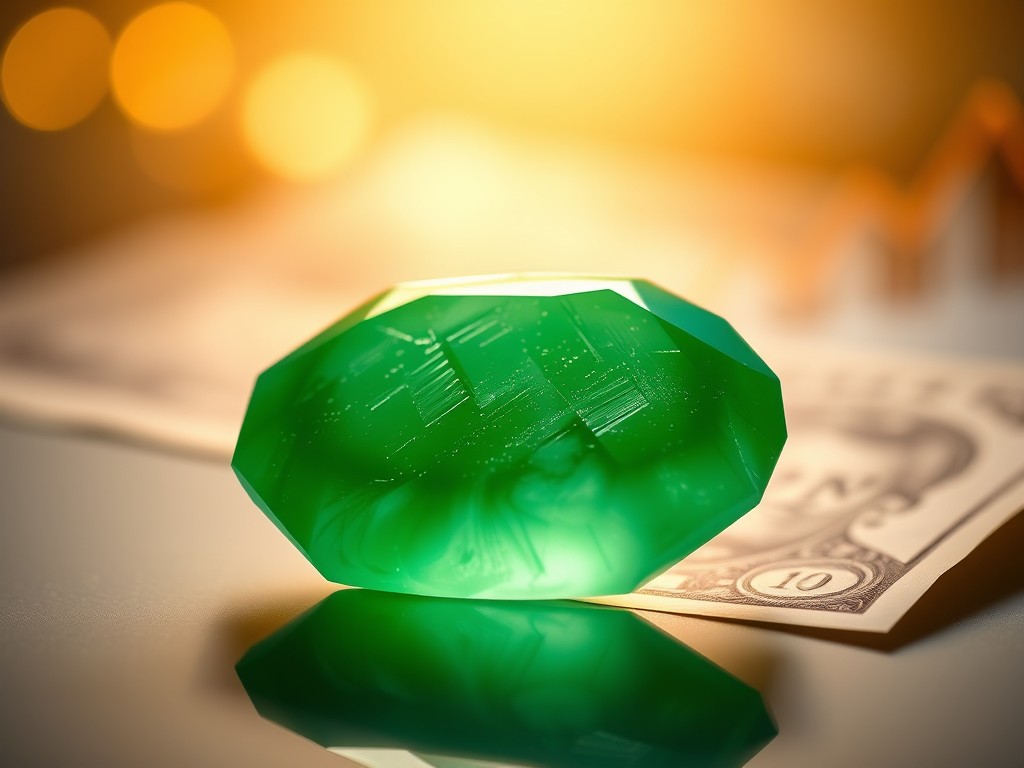
# **Jadeite Investment Guide: The Scarcity Value and Market Potential of High-Quality Jadeite**
Jadeite, one of the most precious gemstones in Eastern culture, is highly favored by investors due to its delicate texture, unique colors, scarcity, and deep cultural significance. Especially high-quality jadeite (such as Imperial Green jadeite) is not only a symbol of status and taste but also a robust and potentially limitless long-term investment. This article will comprehensively explore the investment value of high-quality jadeite, market performance over the past decade, investment costs, risks, channels, preservation methods, factors for value assessment, methods of authentication, and other key information to help you make informed decisions in jadeite investment.
—
## **1. Investment Value of Jadeite**
### **1. Scarcity and Natural Appeal** – **Scarcity**: High-quality jadeite mainly comes from Myanmar, with a limited global supply, and the proportion of investment-grade jadeite is extremely small. As premium deposits gradually deplete, the supply of top-grade jadeite is becoming increasingly tight. – **Natural Appeal**: The unique colors, texture, and luster of jadeite make it an irreplaceable natural wonder. In particular, “Imperial Green jadeite,” known for its pure and rich green color, is regarded as the “king” of jadeite, with prices reaching new highs.
### **2. Cultural Value** Jadeite is revered in Eastern culture as the “king of jade,” symbolizing good fortune, wealth, and health. This profound cultural significance creates high demand in Asian markets, especially in China and Southeast Asia.
### **3. Long-Term Value Preservation and Appreciation Potential** – **Inflation Resistance**: As a scarce asset, jadeite can effectively preserve its value during inflationary periods. – **Stable Appreciation**: Due to its scarcity and growing demand, high-quality jadeite has seen a steady price increase over the past few decades, making it a reliable long-term investment.
—
## **2. Investment Returns of Jadeite: Market Performance Over the Past Decade**
### **1. Steady Price Increases** According to market data, jadeite prices have averaged an annual growth rate of about **8%-15%** over the past decade, with top-grade jadeites (such as Imperial Green and glass-type) seeing even more significant increases.
– **Imperial Green Jadeite**: Since 2013, its price has increased by approximately 2-3 times. From 2016 to 2023, some high-end jadeite auction items have seen yearly price increases of **20%-25%**. – **Glass-Type Jadeite**: Known for its translucent texture, this type of jadeite has had a stable price increase of about **10%-15%**.
### **2. Impressive Auction Market Performance** – **2014: Myanmar Jadeite “Imperial Green Necklace”** – Final Price: **$27 million** (Christie’s). – Significance: This necklace set a jadeite auction record due to its pure color and top quality.
– **2021: Natural Jadeite Bangle** – Final Price: **$12 million** (Sotheby’s). – Significance: Indicates strong market demand for top-grade jadeite.
—
## **3. Investment Costs of Jadeite**
### **1. Purchase Costs** Jadeite prices vary based on quality, size, and craftsmanship. Here are reference prices in the market: – **Top-Grade Imperial Green Jadeite**: Prices can reach **$50,000-$100,000** per carat, or even higher. – **Glass-Type Jadeite**: Prices range from **$10,000-$50,000** per carat. – **Ice-Type Jadeite**: Prices are approximately **$3,000-$10,000** per carat.
### **2. Related Costs** – **Certification Fees**: The certification cost for high-quality jadeite is about **$100-$500**, with detailed analysis potentially costing more. – **Insurance Costs**: Annual insurance fees typically range from **0.5%-1%** of the jadeite’s value. – **Auction or Transaction Fees**: Auction houses charge **10%-25%** of the final sale price as a fee.
—
## **4. Investment Risks of Jadeite**
### **1. Risk of Counterfeits and Treated Stones** The market is flooded with artificially treated jadeite (such as dyed or resin-filled jadeite), making it difficult for ordinary buyers to distinguish authenticity. Caution is required when choosing trading partners.
### **2. Liquidity Risk** The liquidity of the jadeite market is relatively low, especially for high-priced jadeite, which may take longer to sell.
### **3. Market Volatility** Jadeite prices can be influenced by economic conditions, demand fluctuations, and may experience short-term volatility.
—
## **5. Investment Channels for Jadeite**
### **1. Auction Houses** – **Christie’s** and **Sotheby’s** are top auction houses for jadeite globally, offering professionally certified high-quality jadeite auction items. – **Advantages**: Guarantees the source and quality of jadeite, with high market recognition.
### **2. High-End Jewelry Brands** – Some well-known jewelry brands (such as **Cartier** and **Van Cleef & Arpels**) sell high-quality jadeite with authoritative certification.
### **3. Professional Jadeite Trading Markets** – Jadeite trading markets in Asia (like Hong Kong and Myanmar) are major investment channels, but require professional knowledge to distinguish authenticity.
### **4. Jewelry Brokers** – Private transactions through reputable jewelry brokers are suitable for investors seeking rare jadeite.
—
## **6. Collection and Preservation Methods**
### **1. Proper Storage** – Jadeite should be kept away from direct sunlight, high temperatures, and chemicals. It is recommended to store it in specialized jewelry boxes to maintain appropriate humidity.
### **2. Regular Maintenance** – Jadeite requires regular cleaning and maintenance to preserve its luster and color.
### **3. Purchase Insurance** – Purchase specific insurance for high-value jadeite covering risks such as theft and damage.
—
## **7. Factors for Valuing Jadeite**
### **1. Type (Texture)** – The delicacy and transparency of jadeite, referred to as “type,” with glass-type and ice-type jadeite having the highest value.
### **2. Color** – The best jadeite colors are characterized as “pure, rich, bright, and even,” with the purest “Imperial Green” being the most precious.
### **3. Craftsmanship** – The level of detail in carving and design can significantly impact jadeite’s value.
### **4. Weight and Size** – Generally, larger and more complete-shaped jadeite is more valuable.
### **5. Source** – The origin of jadeite (such as Myanmar) and provenance significantly influence its price.
—
## **8. Methods for Authenticating Jadeite**
1. **Professional Certification Institutions** – Choose authoritative certification institutions like **NGTC (National Gemstone Testing Center of China)** or **GIA (Gemological Institute of America)** to confirm the natural quality of jadeite.
2. **Observation of Features** – Genuine natural jadeite typically exhibits a fine structure and natural color, while artificially treated jadeite may show overly uniform coloring.
3. **Testing Techniques** – Use ultraviolet lamps, infrared spectroscopy, or high-powered microscopes to examine jadeite’s structure and internal features.
2. **Choose Trading Channels** – Purchase high-quality jadeite through auction houses or reputable jewelers.
3. **Authenticate** – Ensure jadeite comes with an authoritative certification.
4. **Proper Storage and Insurance** – Store it in a secure environment and purchase insurance for the jadeite.
5. **Long-Term Holding** – Jadeite is suitable for long-term investment, with a recommendation to hold for at least **5-10 years**.
—
## **10. Related Costs and Regulations**
### **1. Auction House Fees** – Auction houses typically charge **10%-25%** of the sale price as a fee.
### **2. Tax Considerations** – Selling jadeite may incur capital gains tax, with specific rates depending on the country.
### **3. Import and Export Regulations** – Some countries have special restrictions on jadeite imports and exports, requiring relevant documentation (such as provenance certificates).
—
## **11. Other Important Information**
### **1. Regional Differences in the Jadeite Market** – China and Southeast Asia are the main markets for jadeite, with cultural value and demand significantly higher than in Europe and North America.
### **2. Investment Diversification** – Jadeite can be part of a jewelry investment portfolio, combined with diamonds and colored gemstones to spread risk.
—
## **12. Conclusion**
High-quality jadeite, with its scarcity, cultural value, and stable market performance, has become a shining star in the jewelry investment world. By selecting top-tier jadeite, carefully authenticating, and properly preserving it, investors can fully leverage the long-term appreciation potential of jadeite. Whether it’s the top collections of Imperial Green jadeite or the stable returns of glass-type jadeite, jadeite offers investors unparalleled wealth and artistic enjoyment.
# **Information on Myanmar Jadeite Mining Areas and Future Production Forecast**
Myanmar is the world’s primary source of jadeite, particularly high-quality jadeite (such as Imperial Green jadeite and glass jadeite), which accounts for the vast majority of global production. However, due to resource extraction pressures, policy factors, environmental issues, and geopolitical influences, the jadeite industry in Myanmar is facing numerous challenges. Below is a detailed analysis of Myanmar’s jadeite mining areas and future production forecasts.
—
## **1. Major Jadeite Mining Areas in Myanmar**
Jadeite mining areas in Myanmar are primarily concentrated in Kachin State in the north, especially the **Hpakant region**, which is regarded as the “heart” of jadeite production globally. Here are the distributions and characteristics of the main jadeite mining areas in Myanmar:
### **1. Hpakant Mining Area** – **Location**: Located in northern Kachin State, bordering China. – **Characteristics**: – Hpakant is the main source of jadeite worldwide, possessing the richest jadeite reserves. – The area primarily produces top-quality jadeite, including Imperial Green jadeite, glass jadeite, and ice jadeite. – The deposits are mostly secondary, with jadeite found in riverbeds and underground rock layers. – **Current Situation**: – Since the 1990s, jadeite extraction in Hpakant has significantly increased, but over-extraction has led many high-quality deposits to approach exhaustion. – Environmental degradation and illegal mining are serious issues, prompting the government to tighten regulations in the area.
### **2. Mawlu-Mawhan Mining Area** – **Location**: Located northwest of Hpakant, adjacent to the Hpakant mining area. – **Characteristics**: – Mainly produces medium to high-quality jadeite, such as ice and mushy jadeite. – The scale of the deposits is smaller, but they still have some market value. – **Current Situation**: – Compared to Hpakant, extraction activities in Mawlu-Mawhan are less frequent, and the quality of jadeite is relatively stable, but reserves are limited.
### **3. Lonkin Mining Area** – **Location**: Near the Hpakant mining area. – **Characteristics**: – Produces mostly medium to low-quality jadeite (such as bean jade), but in large quantities. – Suitable for making mid-range jadeite jewelry to meet public market demand. – **Current Situation**: – The mining area still holds some potential, but the proportion of high-quality jadeite is low.
—
## **2. Current Status and Challenges of the Myanmar Jadeite Industry**
### **1. Resource Depletion** – After decades of intense extraction, high-quality jadeite reserves in Myanmar (especially Imperial Green and glass jadeite) have significantly decreased. – Many secondary deposits in Hpakant are nearing exhaustion, and new discoveries of high-quality deposits are becoming rarer.
### **2. Political and Legal Factors** – **Government Regulation**: The Myanmar government has strengthened regulation of jadeite extraction, especially cracking down on illegal mining activities, leading to reduced supply. – **International Sanctions**: Due to Myanmar’s political turmoil (such as military rule), Western countries have imposed economic sanctions, affecting jadeite export trade. – **Licensing Restrictions**: The government has limited the issuance of new jadeite extraction permits and closely controls the scale of existing mining areas.
### **3. Environmental Issues** – Decades of over-extraction have caused severe environmental damage in Hpakant, including deforestation, soil erosion, and water pollution, further complicating jadeite extraction.
### **4. Illegal Mining and Smuggling** – Despite the government’s strict crackdown on illegal mining and jadeite smuggling, rampant illegal activities continue due to strong market demand, disrupting the legitimate jadeite market.
—
## **3. Future Production Forecast for Myanmar Jadeite**
### **1. Decrease in High-Quality Jadeite Production** – According to market analysis, the overall production of high-quality jadeite in Myanmar is expected to **drop significantly in the next 10-20 years**, particularly the output of Imperial Green and glass jadeite, which may decrease by **50%-70%**. – **Reasons**: – Depletion of reserves: Most known high-quality jadeite deposits have been mined or exhausted. – Government policies: The Myanmar government is limiting new mining area development to protect resources and the environment.
### **2. Stable Supply of Medium to Low-Quality Jadeite** – The reserves of medium to low-quality jadeite (such as mushy and bean jade) are relatively abundant, and stable supply is expected in the future, but market demand and price increases for these types of jadeite are limited.
### **3. Rising Prices in the Jadeite Market** – As the supply of high-quality jadeite decreases, market prices are expected to steadily rise over the next decade, with an average annual increase of **10%-15%**, especially in China and Southeast Asia. – **Top Jadeite Market**: Due to increased scarcity, the prices of top jadeite (Imperial Green and glass jade) may see even faster growth, potentially setting new highs in the auction market.
—
## **4. Impact of Myanmar Jadeite on the Global Market**
### **1. Strong Demand in the Chinese Market** – China is the largest consumer market for jadeite globally, with its cultural value making jadeite a symbol of status and wealth. – As China’s economy grows and the middle class expands, demand for high-quality jadeite continues to rise, further driving up jadeite prices.
### **2. Increasing Supply-Demand Imbalance** – The imbalance between the decreasing supply of high-quality jadeite and the growing market demand will lead to rapid price increases, attracting more investors to the market.
### **3. Diversification of the Jadeite Market** – As jadeite production in Myanmar declines, jadeite from other countries (such as Guatemala) may enter the market, but its quality and cultural value are far inferior to that of Myanmar jadeite.
—
## **5. Future Outlook and Investment Recommendations**
### **1. Golden Opportunity to Invest in High-Quality Jadeite** – With high-quality jadeite from Myanmar becoming increasingly scarce, now is the golden opportunity to invest in Imperial Green and glass jadeite. Prices for these jadeites are expected to grow exponentially over the next decade.
### **2. Focus on Legal Provenance** – Investors should choose jadeite with legal provenance and authoritative certification to avoid illegally mined or smuggled jadeite, ensuring that the investment has long-term value.
### **3. Monitor Political and Policy Changes in Myanmar** – The political situation and government policies in Myanmar will directly impact the supply and prices of jadeite. Investors should closely monitor related regulations and changes in international trade policies.
### **4. Invest in High-End Jadeite Auction Items** – Participating in high-end jadeite auctions at international auction houses like Christie’s and Sotheby’s is the best way to acquire top-quality jadeite, which has significant appreciation potential.
—
## **6. Conclusion**
Myanmar jadeite, as one of the rarest and most culturally valuable gemstones in the world, has become an important component of the jewelry investment market. However, with the depletion of Myanmar’s deposits and the influence of environmental and policy factors, the supply of high-quality jadeite will decrease annually, and market prices are bound to rise further. For investors, choosing high-quality jadeite with legal provenance and holding it long-term is a wise strategy for achieving stable returns. Additionally, closely monitoring the dynamics of the Myanmar jadeite industry will help seize market opportunities and reduce investment risks.