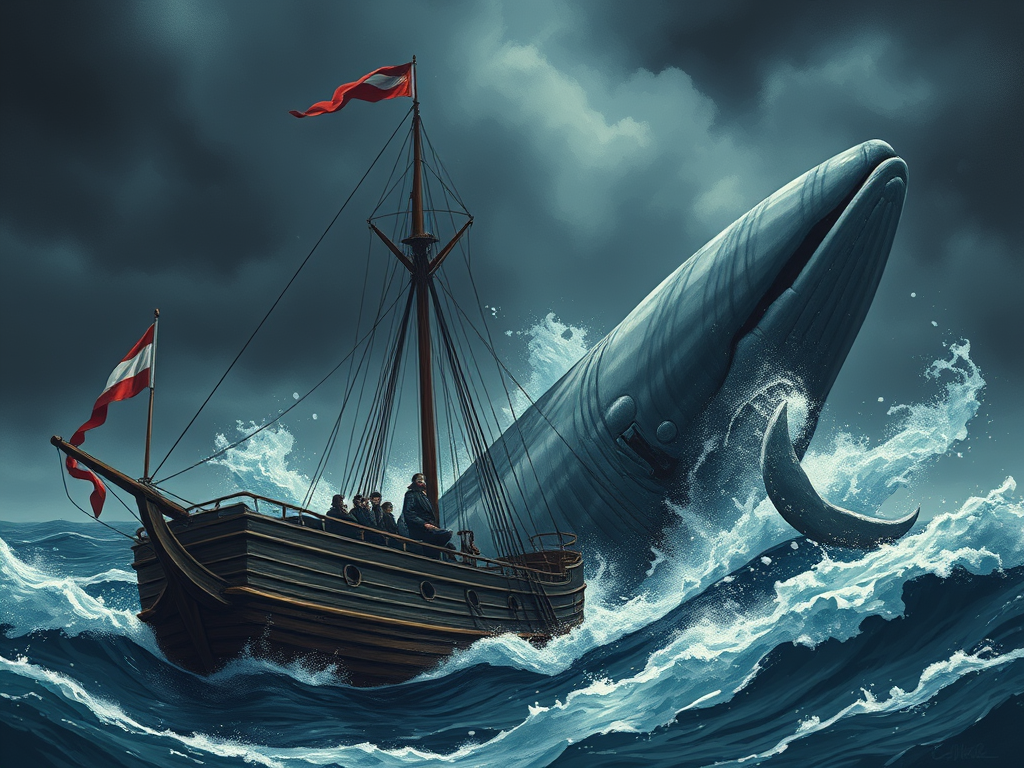
1 The name of this book
Moby-Dick
2 Author of this book
Herman Melville
3 The type of book
Novel
4 The year this book was published
1851
5 Introduction to this book
Moby-Dick follows the adventures of Ishmael, a sailor, as he sets out on a whaling voyage on the whaling ship Pequod, commanded by Captain Ahab. Ahab is obsessed with hunting down the infamous sperm whale, Moby Dick, who bit off his leg in a previous encounter. The narrative weaves together themes of obsession, fate, nature, and the human condition.
6 The central meaning of this book
At its core, Moby-Dick explores the dangers of obsession and the destructive nature of revenge. It delves into the complex relationship between man and nature, with the whale symbolizing the uncontrollable forces of the universe.
7 Your opinion of this book includes characters (if any), point of view, plot of a play(if any), plot (if any)
Moby-Dick is a masterpiece of American literature, characterized by its rich, symbolic language and philosophical depth. The characters, especially Captain Ahab and Ishmael, are multi-dimensional and compelling. Ahab’s monomaniacal pursuit of Moby Dick drives the plot, while Ishmael’s reflective narration provides insight into the human condition. The novel is told from Ishmael’s first-person perspective, which adds a layer of introspection to the adventure story. The plot is gripping, as the crew of the Pequod faces various challenges on their quest to hunt the white whale.
8 What is worth discussing about this book? What should I pay special attention to?
One should pay special attention to the novel’s symbolism, particularly the symbolism of the whale and the sea. The themes of obsession, fate, and the human struggle against nature are worth discussing, as well as the philosophical and metaphysical questions raised throughout the book. The novel’s structure, which alternates between narrative and expository chapters on cetology, is also worth exploring.
9 How can the content of this book help people in their daily lives?
Moby-Dick can help people reflect on the consequences of obsession and the importance of maintaining balance in life. It encourages readers to consider their relationship with nature and the world around them, fostering a sense of humility and respect for forces beyond human control. The novel also promotes empathy and understanding through its diverse cast of characters.
10 What other readers thought of this book
Many readers consider Moby-Dick to be one of the greatest novels in American literature, praising its depth, symbolism, and philosophical insights. Some find the novel challenging due to its complex language and structure, while others appreciate the adventure and character development. Overall, Moby-Dick has garnered widespread critical acclaim and has inspired numerous adaptations and interpretations.
11 What could be improved about this book?
Some readers may find the expository chapters on cetology to be lengthy and distracting from the main narrative. Additionally, the novel’s language and structure can be challenging for some readers, which could be streamlined to make the story more accessible.
12 If you were asked to create a similar book, how would you write it and what would be different?
If I were to create a similar book, I would focus on a protagonist driven by obsession, but in a different context, such as a modern-day setting or a different type of quest. I would maintain the philosophical and symbolic elements but use a more straightforward narrative structure to make the story more accessible to a wider audience. The relationship between the protagonist and the object of their obsession would be explored in depth, with a focus on character development and emotional resonance.
13 Are there any similar book recommendations?
If you enjoyed Moby-Dick, you may also appreciate these similar novels:
– “The Old Man and the Sea” by Ernest Hemingway
– “Heart of Darkness” by Joseph Conrad
– “Lord of the Flies” by William Golding
– “The Sea-Wolf” by Jack London
– “Billy Budd” by Herman Melville

Leave a Reply