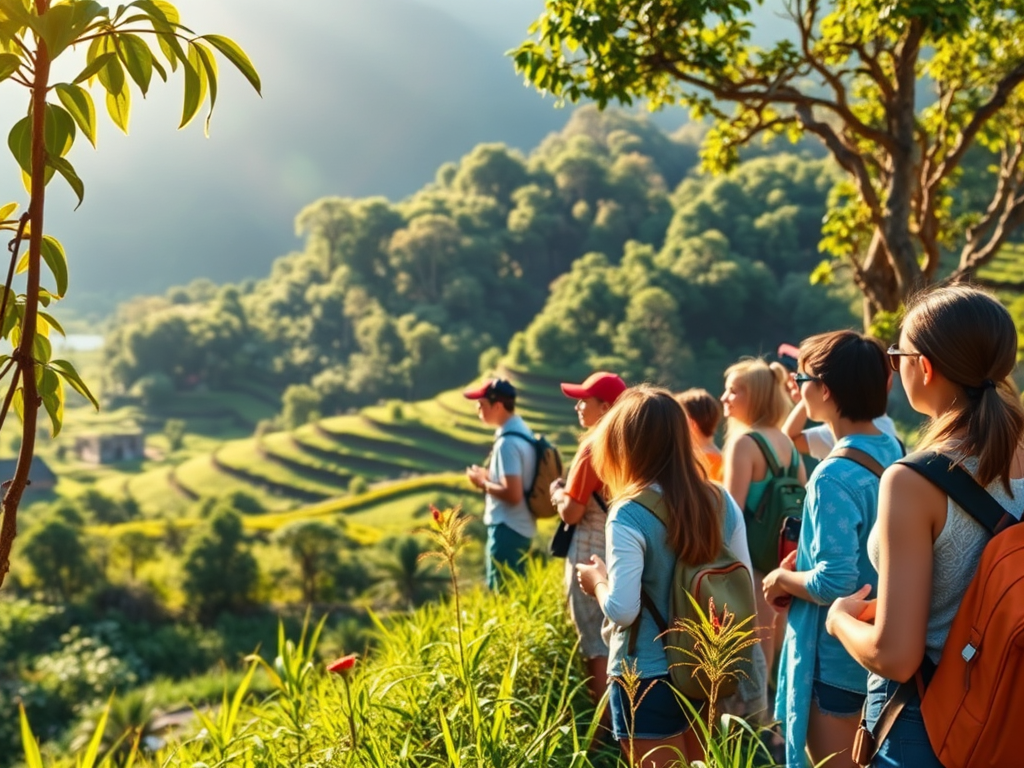
### Business Plan: Sustainable Eco-Tourism in Bali, Indonesia
—
**1. Business Overview:**
Our business, “Green Trails Bali,” operates in the eco-tourism industry. It is located in Ubud, Bali, Indonesia. The business focuses on providing guided eco-tours that promote sustainable tourism, educating tourists on local biodiversity, and supporting conservation efforts.
—
**2. Target Market:**
The primary target market consists of environmentally conscious tourists from Australia, Europe, and North America, aged 25-55, who are interested in immersive experiences that contribute positively to the local environment and community.
—
**3. Direct Competitors:**
– **Bali Eco Tours** – A well-established eco-tourism company.
– **Bali Adventure Tours** – Focuses on adventure and eco-tourism.
– **Market Leader:** Bali Eco Tours is currently the market leader, known for their extensive range of eco-friendly activities.
—
**4. Competitive Advantages and Market Positioning:**
Our competitive advantages include exclusive partnerships with local conservationists, offering unique experiences like night treks and biodiversity workshops. We position ourselves as a premium eco-tourism provider, focusing on depth of experience and sustainability impact.
—
**5. The 4Ps:**
– **Product/Service:** Guided eco-tours, workshops on sustainability, and conservation projects.
– **Price:** Premium pricing model, with tours ranging from $150 to $300 per person.
– **Promotion:** Digital marketing through social media, partnerships with eco-conscious travel bloggers, and collaborations with international environmental organizations.
– **Place/Distribution Channel:** Based in Ubud with tours accessible through online bookings and local agents.
—
**6. Employment Needs:**
We plan to hire 10 employees:
– 1 Manager
– 2 Tour Guides
– 1 Marketing Specialist
– 1 Administrative Assistant
– 5 Part-time Ecologists/Conservationists
—
**7. Risks and Problems:**
– Seasonal fluctuations in tourism.
– Regulatory changes regarding land and wildlife conservation.
– Potential natural disasters like earthquakes and volcanic eruptions.
—
**8. Customer Appeal:**
Customers will choose our service for its unique educational component, authentic Balinese experience, and the direct positive impact of their tourism dollar on local conservation efforts.
—
**9. Business Cost Breakdown:**
– **Equipment:** $50,000 (vehicles, binoculars, educational materials)
– **Shop Rent:** $12,000 per year (office space in Ubud)
– **Staff Costs:** $120,000 annually
– **Utilities:** $3,600 per year (electricity, water)
– **Marketing:** $30,000 per year
– **Taxes:** $20,000 per year
– **Interest:** $10,000 per year (if borrowing $500,000 at 2% interest)
– **Total Initial Investment:** $935,600
—
**10. Additional Funding:**
We can apply for a tourism development grant from the Indonesian Ministry of Tourism, potentially securing an extra $100,000. Additionally, low-interest loans are available through government-backed schemes for sustainable initiatives.
—
**11. Financial Projections:**
– **Estimated Return:** 20% annual return after the first year.
– **Capital Recovery Period:** 5 years.
– **Annual Earnings Post-Recovery:** Approximately $200,000 per year.
—
**12. Market Research:**
We conducted surveys and focus groups in key international markets, confirming a growing interest in eco-friendly travel options and a willingness to pay premium prices for unique, educational experiences. Our research also shows a favorable trend towards sustainable tourism in Bali.
—
**13. SWOT Analysis:**
– **Strengths:** Unique offerings, partnerships with conservationists, strong market demand for eco-tourism.
– **Weaknesses:** High initial costs, dependence on seasonal tourism.
– **Opportunities:** Expanding to other parts of Indonesia, offering online workshops.
– **Threats:** Economic downturns affecting tourism, natural disasters.
—
**14. Stages of Business Development:**
– **Stage 1 (Launch):** Set up operations, hire staff, launch marketing campaigns.
– **Stage 2 (Growth):** Expand tour offerings, increase staff, develop online educational programs.
– **Stage 3 (Expansion):** Open additional locations in other parts of Indonesia, refine and diversify service offerings.
—
**15. Market News and Summary:**
Recent market trends indicate a rise in sustainable tourism, with Bali being a key destination. This business leverages these trends by offering a unique, educational, and impactful tourism experience. By investing in “Green Trails Bali,” you are not only tapping into a growing market but also contributing to the conservation efforts in one of the world’s most biodiverse regions.
**Reminder:** Investing in any business carries risks, including the potential to lose your capital. It is important to carefully consider this opportunity and consult with financial advisors before making an investment decision.

Leave a Reply